
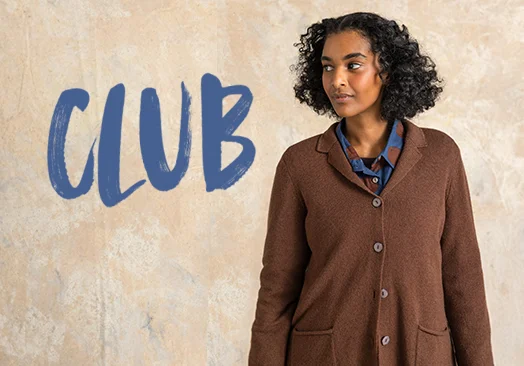

Textile materials
Nature has given us cotton, linen, wool and silk with which to create thread, while modern technology transforms wood cellulose into viscose, modal and lyocell. We love natural materials, preferably recycled and regenerative, for designing garments with a long lifespan and that continuously return to the circular economy. Reuse, recycle and repurpose – we work according to these concepts. Organic cotton jersey has been part of our assortment since the 1990s – and we are proud of this fabric!

CottonOne of our favorite fibers, cotton, is versatile and useful. A distinction is made between carded cotton which is porous and rather coarse, and combed cotton which is less porous and has a smooth surface.
Organic cotton is grown without chemical pesticides and fertilizers. Another good alternative in terms of the environment is recycled cotton from textile production, as well as from discarded garments and textiles.

WoolWool is a biodegradable super-fiber and one of our favorite materials, because of its fantastic and unique properties.
It is warm when cold and damp, and it also has a cooling effect in summer. Wool fat, or lanolin, makes the material naturally self-cleaning and dirt-repellent. This means wool garments can be aired instead of washed, allowing you to use the garment for longer between washes.
Our wool is from mulesing-free production, which means that the painful method for preventing flystrike is not used. Wool fabric, particularly if it is soft and woolly, may pill. That is completely natural and pilling can easily be removed by hand or with a fabric shaver.
Beautiful garments in warm wool »

Merino woolfrom merino sheep, has wool fibers that are fine, naturally crimped and soft.
Our merino wool is mainly from South Africa or South America, and is mulesing-free. Mulesing is a painful practice involving merino sheep. We also use organically certified wool fiber and wool dyeing, where possible.

Cashmerewhich is soft and fine, is made from the undercoat fibers of domesticated goats that live in cold climates.
The name comes from the Kashmir region of northern India.

Alpaca woolAlpaca wool is a lovely material with soft, long fibers that offer a supple, comfortable feel.
It is light and warm, and its natural sheen creates a beautiful, vivid texture. Garments made in alpaca wool can be aired, which will allow you to wear them for longer between washes.

Yak woolcomes from yak, which have a long-haired coat that produces wool
that is warmer than standard sheep wool, but still lightweight, soft and smooth.

FlaxFlax is historically the most commonly used fiber for clothing in Sweden. We prefer to use dew-retted flax.
Dew-retting is an old processing method in which the flax is laid out in the fields so the dew and rainfall can take care of the retting process, which naturally releases the fiber.
The linen fabric made from flax is prized to this day for its smoothness, dirt-repellence and washability. One of the few drawbacks is its tendency to wrinkle, but that is often seen as the whole appeal of linen!

SilkSilk is made of silk fiber, spun by butterfly larvae, and which can be both cultivated and wild.
The most common kind of cultivated silk is from butterflies that eat mulberry leaves – so-called mulberry silk. Butterfly larvae spin the raw silk thread inside their cocoons, and the thread can be over 1,000 meters long! Wild silk fiber is coarser and more uneven in texture than cultivated silk, but has its own special charm.

Regenerated fibersWe gladly use regenerated fibers that are made from naturally grown organic material, usually cellulose (different kinds of wood), which is dissolved and then regenerated into fibers.
We use soft and beautiful TENCEL™ Modal and TENCEL™ Lyocell, made in Lenzing’s closed-loop system, in which water and necessary chemicals are recovered and reused.
Many regenerated fibers are very soft against the skin, with properties similar to cotton. The fibers often have a beautiful sheen and a lovely drape, and wrinkle less than cotton because they are elastic. Because the fibers are straight, they are also easier to clean than cotton.

ViscoseViscose, previously called rayon, is a regenerated fiber made of cellulose from spruce or other trees.
The cellulose is turned into a pulp that is spun into different kinds of fibers. Viscose fibers have good absorption, but are sensitive and weak when wet and can wrinkle easily in the wash. Garments made of viscose are soft against the skin and have a beautiful drape.

LENZING™ ECOVERO™ Viscose This is an airy and supple material produced from certified wood cellulose from sustainable forestry, and the cellulose is also produced in a closed-loop process that therefore saves water and reduces emissions.
LENZING™ ECOVERO™ Viscose fiber is produced with at least 50% less carbon dioxide emissions and water consumption compared to generic viscose*.
*Results based on LCA standards (ISO 14040/44) and available via Higg MSI (version 3.7).

Recycled fibersFor our recycled fibers, we usually use scraps from textile production made for example of cotton, linen, wool, polyamide and polyester.
Continuous development of recycled fibers is underway on the market.

Textile finishesFor our wind-resistant garments, a fluorine-free finish is used that makes them water-repellent.
Our rainwear is finished in the same way, but also has a polyurethane coating on the inside and taped seams for full waterproofing.

CertificationsWe set high demands for transparency and certification of the production of our organic and recycled materials.
All producers must be approved by independent certification bodies. We have certificates for materials such as cotton, linen and wool at the fiber level to processes such as dyeing, printing and the actual manufacturing. For most of our products, the entire production chain is certified – from fiber to manufacturing.
The fibers and materials for which we require a certificate are TENCEL™ Lyocell, TENCEL™ Modal, TENCEL™ Modal x Micro, LENZING™ ECOVERO™ Viscose, recycled material, organically grown and certified cotton/linen/hemp, organically certified wool, Swedish wool, RWS wool, RAS alpaca, CmiA and BCI cotton, FSC® certified wood and natural rubber. TENCEL™, LENZING™ and ECOVERO™ are trademarks of Lenzing AG.

Bamboo fibersBamboo grows in tropical, sub-tropical and temperate regions of Asia and produces a good raw material.
It grows quickly in nutrient-poor soil and does not require any pesticides or artificial irrigation. The naturally durable properties of bamboo create regenerated fibers, for example bamboo viscose and bamboo lyocell. It is nice and soft against the skin.